

Google’s new AI features for Search present a further challenge to publisher referral traffic, according to SEO experts.
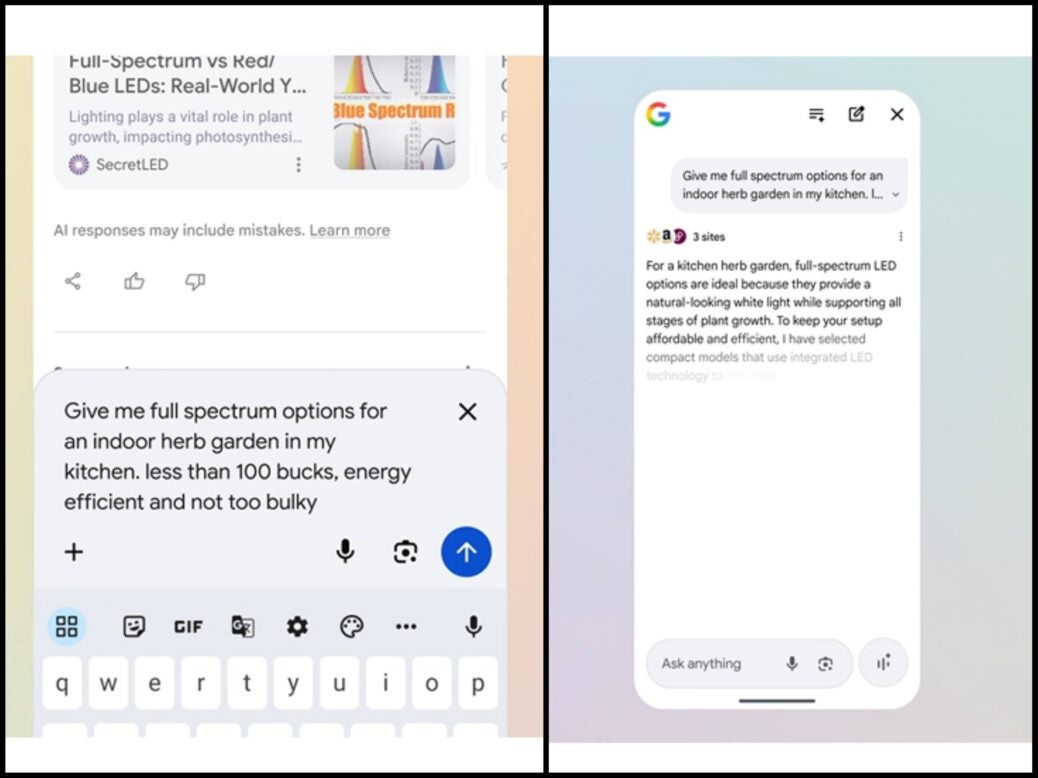
The changes, initially revealed in January before further details came out this month, include the introduction of AI agents Google users can delegate search tasks to.
Google AI Mode, which was made available to all US users in May 2025 before expanding to the UK in July, goes further than AI Overviews by offering a more conversational ChatGPT-style experience.
Announcing Google AI’s update in January, Robby Stein, vice president of product at Google Search, said: “We’re making the transition to a conversation even more seamless. Now, you can easily ask a follow-up question right from an AI Overview, and jump into a conversational back and forth with AI Mode.”
Google confirmed to Press Gazette that the transition to AI Mode will be optional meaning users will continue to see blue web links in the results below AI summaries.
Further updates announced on 19 May included Search introducing the ability to show interactive visuals, graphs, and blog-style trackers (such as a health tracker), to submit photos and files into Search and to use AI agents.
Unlike AI Overviews, the agents are designed to carry out ongoing tasks such as tracking products, sports updates or new content related to a user’s query.
These agents will be able to shortcut the process of web search by creating notifications, said Lily Ray, founder of SEO and AI search consultancy Algorythmic, on Linkedin.
“Search can take complex questions and map out a plan – you can then get automatic notifications directly from Search to help you answer your question,” she said.
Google described the update as the “biggest upgrade” to Search in more than 25 years. It is rolling out in all countries where AI Mode is available on desktop and mobile, with the US first to see the update in the summer.
[Read more: Health coverage is getting killed by Google AI Overviews]
Cut into organic traffic ‘across the board’
Ray said AI Mode not becoming the default search experience “is a big deal” and that “many businesses can sort of breathe a small sigh of relief.
“But all of these new search features will absolutely continue to cut into organic traffic across the board,* as Google provides many more features, tools, and experiences directly in the Search interface.
“That said, I imagine conversion rates will improve for retailers, ecommerce stores, and local businesses, as users get more personalised and tailored results.”
Ray said AI Mode as a default Google Search experience will happen “once they figure out how to drive as much ad revenue from AI Mode as they currently generate from organic search”.
Jibon Kumar Jith, SEO manager at Rooy SEO, commented on the post: “The real trap here is the ‘interactive follow-up’ pushing users into AI Mode,” adding that this means Google’s more traditional search page will “handle the initial click, only to aggressively lock users into a zero-click loop the second they ask a clarifying question”.
Latest Google AI update is ‘one more nail in the coffin’
Steve Wilson-Beales, SEO and content strategy consultant, told Press Gazette the update indicates “the general direction of travel” for publisher traffic.
“You could argue that top of funnel or head term searches have already been siphoned away by AI Mode and AI answers so if you’re a publisher still following that strategy, then this announcement is just one more nail in the coffin,” he said.
“Not many users will initially use Google’s new agentic workflow – but it is indicative of the general direction of travel. Google is all about Google, and publishers that are over-reliant on any one platform are going to suffer most.”
Google AI update may not impact users ‘searching for news’
However news SEO consultant Barry Adams, also founder of the News & Editorial SEO Summit, told Press Gazette the update shouldn’t have “a major additional impact on publishers”.
“It seems more that Google is building a more interactive search ecosystem,” he said. “I don’t see how this directly impacts when people are searching for news. I think Google will still serve classic search results in those regards – Top Stories boxes and things like that.”
He said Google’s new ability to give notifications on specific articles being published or items being in stock “might have an impact a little bit on how people consume content or search for content if there is a large degree of user adoption”, but added he doesn’t expect this to happen.
Adams said he doesn’t think “many people will embrace” the advanced Search.
“I think the Search field is a very impulsive driven thing, rather than people planning ahead, people will just… go to Google and search for something,” he said, adding a default transfer from AI Overviews to AI Mode has “already been happening to a certain extent”.
He added this transition therefore “won’t really have any further negative impact on traffic than AI Overviews already have, maybe a little bit more traffic loss”.
“I think if your content is already being replaced by AI Overviews in Google Search then the writing is on the wall, you shouldn’t really be producing more of the content, at least not for the purposes of generating traffic.”
Adams said that he believes breaking news is “relatively safe” from this update.
“Because AI has kept some news as it happens and still needs human reporters to report the news, and then afterwards AI can summarise it. So, publishers heavily focusing on reporting the news should be relatively safe, I think.”
Google: ‘We’re continuing to evolve and improve’
Other new features include the Google search bar providing AI-powered suggestions before a user has completed a query.
A Google spokesperson said: “We continue to send billions of clicks to the web every day. We’re designing these experiences to connect people to the web, and we’re continuing to evolve and improve ways that we display links, encourage exploration, and help people build their audiences.
“You’ll continue to see blue web links in the results, in addition to AI responses, and AI Mode is not the default experience in Search.
“When you do a standard text search in the Search box, or a visual search with Lens, you will continue to see the search results page.
“If your results include an AI Overview, you can choose to follow up in AI Mode. From the new Search box, you can also select the AI Mode button or use the “plus” icon to do an AI Mode search with rich input or advanced tools.”
Last month, Google told the UK’s Competition and Markets Authority that there is “no realistic prospect of harm to publishers in respect of training/fine-tuning of AI models for search and search generative AI features”.
Email pged@pressgazette.co.uk to point out mistakes, provide story tips or send in a letter for publication on our "Letters Page" blog
